9 Best Small Sewing Machines (November 2026)
The best small sewing machines include the Brother Sewing Machine for everyday sewing, the Brother CS7000X Sewing and Quilting Machine LCD for compact quilting, and the SINGER® for thick fabrics.
On this page (8 sections)
- The best small sewing machines for different projects
- How we picked the best small sewing machine
- What size sewing machine fits a small sewing space?
- Is a mini portable sewing machine enough for beginners?
- How should you set up a small sewing machine?
- Which small sewing machine is easiest to carry?
- More guides on this topic
- Which small sewing machine should you choose?
The best small sewing machine for most home projects is the Brother XM2701, with 27 stitches, 6 sewing feet and a free arm in a compact design. That balance makes it a sensible starting point when you want a machine that can handle more than one-off repairs.
A small machine is not just about taking up less space on a shelf. It also needs enough stitch choice, fabric room and easy setup to stay useful for everyday work at home.
We compared compact mechanical, computerized and mini machines for sewing rooms with limited storage. The best choice depends on whether you need stitch variety, a free arm, thick-fabric power, portability or a simple starter setup.
For beginners, threading and bobbin access matter as much as the headline stitch count. A machine that is easy to set up each time is more likely to be used for repairs, hems and small garment projects.
For quilters and thicker fabrics, workspace and frame strength become the priority. A computerized model or a heavy-duty design may suit better even if it takes a little more room.
For travel and quick fixes, weight and power options decide the match. A mini machine can be ideal in a bag or drawer, but it will not replace a full-size machine for larger work.
If you need broader buying advice, read our guide on how to choose a sewing machine. For a more focused portable comparison, see Best Portable Sewing Machines.
Use the picks below as a shortlist rather than a one-size answer. Match the machine to your space, your fabrics and the kind of sewing you actually plan to do most often.
Our picks at a glance
-
1

-
2
 Best for compact quilting
Brother CS7000X Sewing and Quilting Machine LCD
9.5/10 our score
See it on Amazon -
3

- 4
 Check it
SINGER® Heavy Duty 4552™ Next Evolution Sewing
Best for controlled heavy-duty sewing - 5
 Check it
Janome Arctic Crystal Easy-to-Use Sewing Machine
Best for simple beginner sewing - 6
 Check it
Chunara Sewing Machine for Beginners
Best for a starter sewing kit - 7
 Best for supervised small projectsCheck it
- 8
 Check it
KPCB Tech Sewing Machine for Beginners with Fabrics&Finger
Best for guided practice - 9
 Check it
Brother CS5055 Computerized Sewing Machine with LCD
Best for lighter computerized sewing
The best small sewing machines for different projects
The Brother XM2701 is the best all-around compact choice, while the other picks target quilting, thick fabrics, beginner practice and travel repairs. Our score weighs specs, features and buyer feedback against what you're shopping for.
Brother Sewing Machine: Best for everyday sewing
- 27 built-in stitches
- 6 sewing feet
- Automatic needle threader
- Free arm
The Brother XM2701 combines useful stitch variety, a free arm and beginner-friendly threading in a compact corded electric machine.
Pros
- 27 stitches
- 6 included feet
- Free arm for cuffs and sleeves
Cons
- 120-volt US use
- Larger than the mini machines
The Brother XM2701 is the best small sewing machine for everyday sewing because it combines useful range with a manageable 12.6 lb weight. Its 27 built-in stitches include decorative, blind hem, zigzag and stretch options.
The automatic needle threader reduces setup work, and the jam-resistant drop-in top bobbin is easier to monitor while sewing. Six included feet cover common tasks such as zippers, buttonholes, blind hems and button sewing.
The free arm is useful for cuffs, sleeves and pant legs. That makes this a better long-term choice than a basic mini machine if your projects include clothing repairs or simple garments.
The machine is corded electric and intended for US 120-volt use. Its 15.3 x 5.86 x 12.01 in footprint fits many compact work areas, but you'll still need space for fabric and the foot control.
For daily use, set it up where you can see the bobbin area and keep fabric moving freely to the left. Clean around the needle and bobbin area as directed and check the needle before starting a thicker seam.
The trade-off is clear against the mini options in this guide. You gain a fuller feature set and more sewing room, but you give up the very light, battery-ready portability of the smallest machines.
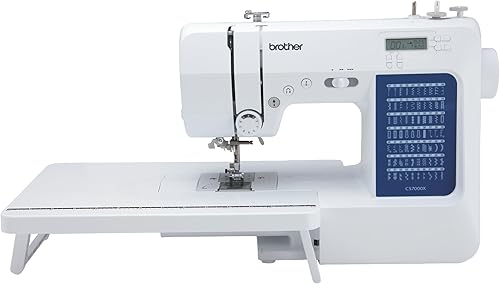
Brother CS7000X Sewing and Quilting Machine LCD: Best for compact quilting
- 70 built-in stitches
- LCD display
- Wide table
- 10 sewing feet and quilt guide
The CS7000X gives small-space sewers a broad stitch selection, a large needle-to-arm workspace and accessories for quilting.
Pros
- 70 stitches
- Wide table
- Protective hard case
Cons
- Heavier than the XM2701
- Needs table space for larger projects
The Brother CS7000X is the best small sewing machine for compact quilting because its 70 built-in stitches, wide table and large needle-to-arm workspace support larger fabric pieces.
Its 10 sewing feet and quilt guide give you more setup options than the XM2701. A protective hard case also helps when you take the machine to a class or move it between storage and a work table.
The LCD display makes stitch selection more direct, while the improved automatic needle threader and drop-in bobbin simplify setup. The fixed needle bar is designed to support cleaner stitching and even lines.
At 14 lb and 17 in wide, it needs more table room than the smallest machines. Choose it when quilting space and stitch variety matter more than the lightest possible body.
The wide table is the practical difference in daily use. It supports the quilt as you sew instead of leaving more weight hanging over the edge of a small surface.
Set aside a clear work area before you start a larger project. You will need room for the machine, the wide table, the fabric and the foot pedal at the same time.
SINGER®: Best for thick fabrics
- 97 stitch applications
- 1,100 stitches per minute
- 50% more power for denim and canvas
- Free arm
The SINGER Heavy Duty 4423 suits frequent sewing and thicker materials, with a metal frame, adjustable presser foot pressure and a high-speed motor.
Pros
- Handles denim, canvas and leather
- 1-step buttonhole
- Included accessories
Cons
- Heavier than most compact picks
- Less convenient to move often
The SINGER Heavy Duty 4423 is the best small sewing machine for thick fabrics because it offers 50% more power than standard sewing machines, according to the product information, and supports denim, canvas and leather work.
Its 97 stitch applications cover seams, decorative work and stretch sewing. The motor reaches 1,100 stitches per minute, so it can move through longer seams quickly when you have the fabric positioned correctly.
A metal frame helps the machine stay steady, and the stainless-steel bedplate supports smooth fabric feeding. Adjustable presser foot pressure gives you more control when switching between lightweight fabrics and thicker layers.
This is a compact heavy-duty machine by footprint, but its 17.1 lb weight makes it less convenient to carry than the Brother or Janome options. Pick it for fabric demands, not for frequent transport.
High speed is most useful on straight, well prepared seams. Slow down for corners, thick layers and detailed sections so the fabric stays under control.
Care is simple but important with heavy-duty use. Keep the needle area clean, use the right needle for the fabric and store the machine where it will not be knocked or dropped.
SINGER® Heavy Duty 4552™ Next Evolution Sewing: Best for controlled heavy-duty sewing
- 32 built-in stitches
- 110 stitch applications
- Speed control
- Even feed and non-stick feet
The SINGER Heavy Duty 4552 adds speed control and bonus presser feet to a metal-frame machine made for thick, layered and lightweight fabrics.
Pros
- Speed control
- 1,000 stitches per minute
- Two bonus presser feet
Cons
- Heaviest pick here
- Takes more storage space than mini models
The SINGER Heavy Duty 4552 is the best small sewing machine for buyers who want heavy-duty power with more speed control. Its 32 built-in stitches create 110 stitch applications for utility, stretch, decorative and garment work.
Speed control lets you set the maximum sewing speed for curves, corners and smaller sections. The machine reaches up to 1,000 stitches per minute for longer seams, while the full metal interior frame supports stability.
The top drop-in bobbin is easy to monitor, and the stainless steel bedplate helps fabric glide. Drop feed supports free-motion monogramming, quilting, button sewing, darning and thread painting.
It includes an even feed or walking foot and a non-stick foot, along with heavy-duty needles and Class 15 bobbins. At 17.2 lb, it's better for a dedicated sewing spot than a machine you move daily.
The speed control is the key difference from the 4423 for many sewers. It lets you keep higher pace for long seams and lower the ceiling when precision matters more.
Adjustable stitch length and width also help you adapt each stitch to the fabric. Test on a scrap first, especially on stretch, layered or heavyweight material.
Janome Arctic Crystal Easy-to-Use Sewing Machine: Best for simple beginner sewing
- 15 built-in stitches
- 4-step buttonhole
- Free arm
- Interior metal frame
The Janome Arctic Crystal keeps controls simple while offering a free arm, adjustable stitch settings and a compact 12 lb design.
Pros
- Beginner-focused controls
- Free arm
- Darning plate included
Cons
- Fewer stitches than the Brother computerized models
- 4-step rather than 1-step buttonhole
The Janome Arctic Crystal is the best small sewing machine for simple beginner sewing because its controls focus on basic tasks without adding a computerized display. It has 15 built-in stitches and a 4-step buttonhole.
The 3-piece feed dog helps move fabric evenly, while the free arm supports cuffs, sleeves and other narrow areas. Adjustable stitch width and length give you room to learn without making the control panel crowded.
The 12 lb body and 7 x 16 x 12 in dimensions make storage easier than with the heavy-duty SINGER models. An interior metal frame adds stability, and the darning plate supports quilting and free-motion sewing.
Four presser feet, bobbins, needles, a seam ripper and quick-start materials are included. Choose it if you want a straightforward machine for garments, patchwork, light quilting and repairs.
The 4-step buttonhole takes a little more attention than a 1-step design. Follow the manual sequence carefully and test the buttonhole on a scrap of the same fabric first.
For care, wipe lint from the feed area and store the machine covered. Simple mechanical controls also mean fewer menus to work through when you return to a project after a break.
Chunara Sewing Machine for Beginners: Best for a starter sewing kit
- 12 built-in stitches
- Dual speed
- Free arm
- 42-piece sewing kit and foot pedal
The Chunara mini machine offers two speeds, a free arm and a 42-piece kit for basic home DIY sewing.
Pros
- Dual-speed operation
- Compact size
- 42-piece kit included
Cons
- Fewer stitches than full-size picks
- ABS construction
The Chunara is the best small sewing machine for a starter sewing kit because it combines 12 built-in stitches, dual-speed operation and a 42-piece sewing kit.
Its free arm is designed for pant legs, sleeves and other cylindrical items. Automatic thread rewind, a thread cutter, a tension dial and a sewing light give beginners several useful controls in a small 12 x 11 x 6 in body.
The machine uses ABS material and supports battery-powered or corded electric operation. The dual-speed setup lets you choose a slower pace while learning or a faster pace for straightforward seams.
This is a practical choice for home DIY projects and limited storage. Its 12 stitches and mini format are less suited to buyers who expect the broader fabric control or workspace of a full-size machine.
The 42-piece kit helps you start without buying basics separately. Check what is included when you set up, then keep the kit together so the machine is ready for quick repairs.
Use the slower speed for practice seams and tight areas. That makes it easier to guide fabric, check your stitch and build confidence before moving to faster work.
Mini Sewing Machine for Kids: Best for supervised small projects
- Dual-speed motor
- AC and battery power
- Foot pedal
- Automatic bobbin winder
The Sew Mighty Mighty Mini is a lightweight option for quick repairs, travel and small craft projects, with AC or battery operation.
Pros
- Very light
- Dual-speed motor
- Works with or without foot pedal
Cons
- Batteries not included
- Not intended as a toy
The Sew Mighty Mighty Mini is the best small sewing machine for supervised small projects, travel repairs and quick light-duty work. Its 399 g weight makes it the easiest pick here to carry.
It runs from standard 110V AC power or 4 AA batteries, although the batteries are not included and AC and battery power cannot be used at the same time. A foot control pedal is included, and the machine can also operate without it.
The two-speed motor, automatic bobbin winder, work light and cuff notch support simple repairs. The box also includes 2 pre-wound metal bobbins, 2 empty metal bobbins and a replacement needle.
The machine is intended for sewing, not as a toy, so children need proper supervision. Choose it for small projects and portability, not for thick layers or a full garment workflow.
Battery power is handy when a wall outlet is not close. Keep spare batteries ready and switch fully between AC and battery use as directed.
For travel, pack the machine, pedal and spare bobbins together. Its light body makes it easy to carry, but it still needs a stable surface and careful handling while sewing.
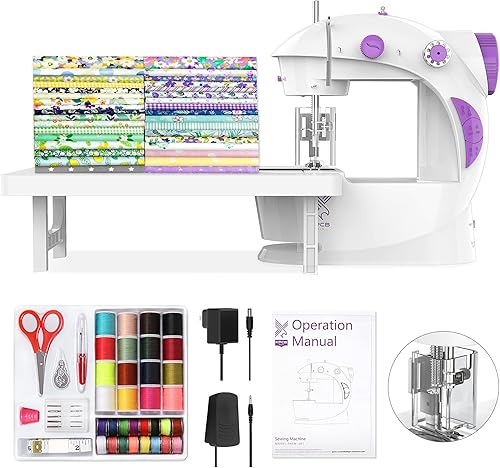
KPCB Tech Sewing Machine for Beginners with Fabrics&Finger: Best for guided practice
- 20 cotton fabric squares
- Finger guard
- Dual speed
- Extension table
The KPCB Tech mini machine pairs slow and standard speeds with practice fabric, a finger guard and a 3 lb body.
Pros
- Very light
- Practice fabrics included
- Finger guard
Cons
- Plastic material
- Mini format limits larger work
The KPCB Tech mini machine is the best small sewing machine for guided practice because it includes 20 8 x 8 in cotton fabric squares, a finger guard and two stitching speeds.
The practice fabric gives beginners material for patchwork and school projects before they move to larger work. Slow and standard speeds also make it easier to build control gradually.
Its double-thread design can sew up to 5 fabric layers without manual knot ending, according to the product information. The machine also includes an extension table and a kit with sewing tools such as bobbins, scissors, measuring tape, a thimble, needle threader and needles.
At 3 lb and 10 x 9 x 6.9 in, it takes very little storage space. The plastic body and mini format make it a better practice and repair machine than a main machine for large projects.
The finger guard is a useful safety feature for new sewers. It helps keep fingers clear of the needle area while you learn how fabric feeds through the machine.
Use the practice squares to test straight seams, turns and stitch patterns. That gives you a low pressure way to learn before cutting into clothing or a larger project.
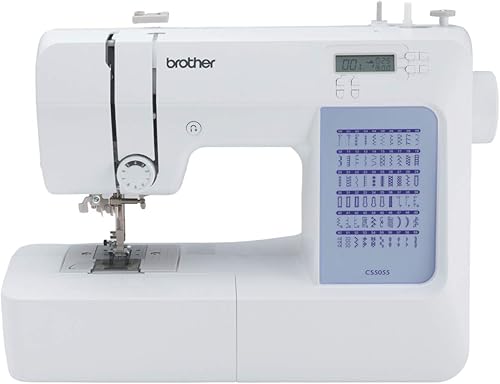
Brother CS5055 Computerized Sewing Machine with LCD: Best for lighter computerized sewing
- 60 built-in stitches
- LCD display
- 7 sewing feet
- 4 bobbins
The Brother CS5055 offers computerized stitch selection and an LCD display in a 10.5 lb machine with a metal frame.
Pros
- 60 stitches
- LCD display
- Lightest full-size computerized pick
Cons
- Fewer accessories than the CS7000X
- 120-volt US use
The Brother CS5055 is the best small sewing machine for lighter computerized sewing when you want many stitch choices in a 10.5 lb body. It includes 60 built-in stitches, an LCD display and 7 sewing feet.
The fixed needle bar supports cleaner stitching and even lines, while the automatic needle threader and jam-resistant drop-in bobbin make setup easier. Its larger needle-to-arm workspace gives you more room than the mini machines.
Four bobbins, a needle set and a trilingual manual are included. The machine has a metal frame and a bright LED-lit work area, according to the product information.
The CS5055 is smaller in weight than the CS7000X, but the CS7000X includes more stitches, 10 feet, a wide table, a quilt guide and a protective hard case. Choose the CS5055 if lighter storage matters more than those extras.
The LCD display makes it easier to select and adjust stitches. That can speed up switching between utility, decorative and heirloom work during a project.
For setup, thread the needle with the automatic threader and seat the drop-in bobbin as directed. Test the stitch on a scrap, then keep the work area clear so larger fabric pieces do not drag.
How we picked the best small sewing machine
The best small sewing machine should fit your available table or shelf while still matching the fabrics and projects you plan to sew. We checked dimensions, weight, stitch count, threading features, free arms, workspace, power options and included accessories.
A compact body does not always mean a mini machine. The Brother XM2701, Janome Arctic Crystal and Brother CS5055 are small enough for many home sewing areas but still offer features for clothing repairs and regular projects.
We also separated portable from lightweight. The Sew Mighty is exceptionally light and can use batteries, while the Brother CS7000X adds a hard case for moving a larger computerized machine.
For fabric strength, the SINGER Heavy Duty 4423 and 4552 rank above the mini models because their product data specifically covers denim, canvas, leather or thick layers. Mini machines are more appropriate when storage and basic work are the main concerns.
We looked at how each machine is set up in daily use. Threading, bobbin access, included feet and work space affect whether a small machine feels easy or cramped.
We also considered care and storage. A machine that is quick to set up, easy to clean and simple to put away is more likely to be used for regular repairs and projects.
What size sewing machine fits a small sewing space?
A small sewing machine should leave room for fabric to the left of the needle, the foot pedal in front and safe handling around the body. Measure your shelf or table, then compare it with the machine's full width, depth and height.
The KPCB Tech is the smallest and lightest option here at 10 x 9 x 6.9 in and 3 lb. The Chunara is 12 x 11 x 6 in, while the Brother XM2701 measures 15.3 x 5.86 x 12.01 in.
The Brother CS7000X and CS5055 share a 17 x 7 x 12 in footprint. They need more table space, but their larger workspace is useful for fabric that would feel cramped on a mini machine.
If you want to compare compact models by portability, read our guide to the best small lightweight sewing machine. For a broader list, see the best lightweight sewing machine options.
Is a mini portable sewing machine enough for beginners?
A mini portable sewing machine is enough for basic repairs, simple crafts and practice, but a full-size compact machine gives you more room to grow. The right choice depends on the type of sewing you expect to do after the first few projects.
Choose the Chunara or KPCB Tech when you want dual speeds and a small body. The KPCB Tech adds practice fabric and a finger guard, while the Chunara includes a 42-piece kit and free arm.
The Sew Mighty is a stronger portability choice because it weighs 399 g and can run on 4 AA batteries. It suits quick repairs and small projects, but it is not the best fit for thick layers or extended garment sewing.
For a handheld approach, read how to use a mini handheld sewing machine and compare the best handheld sewing machines before choosing a format.
How should you set up a small sewing machine?
Set up a small sewing machine on a stable, well-lit surface with enough room for the fabric to move freely. Thread it according to the manual, insert the bobbin correctly and test the stitch on a scrap of similar fabric before starting the project.
Start with a straight stitch and a moderate speed. Check that the thread feeds evenly, the bobbin is seated and the needle moves cleanly before changing stitch patterns or fabric layers.
A free arm helps with cuffs, sleeves and pant legs. For a specific compact setup, see how to use a Magicfly mini sewing machine and how to use a mini sewing machine SM-202A.
Keep the machine covered when stored, remove lint around the needle and bobbin area as directed by the manual and replace a damaged or bent needle before sewing.
Which small sewing machine is easiest to carry?
The Sew Mighty Mighty Mini is the easiest to carry because it weighs 399 g and supports AC or battery power. The KPCB Tech is also easy to move at 3 lb, while the Janome and Brother XM2701 offer more full-size sewing features at about 12 lb.
A carrying case helps protect a machine and keeps accessories together. The Brother CS7000X includes a protective hard case, while buyers choosing another Brother model may need to plan storage separately.
For more portable comparisons, read the best portable sewing machine for beginners and the best portable Brother sewing machine. If you prefer a machine with dedicated storage, see the best portable sewing machine with carrying case.
The Brother XM2701's free arm makes it more useful for portable alterations than a basic mini machine, but its 12.6 lb weight is a trade-off. For a Brother CS7000X, our guide to a Brother CS7000X case covers what to consider before choosing separate storage.
More guides on this topic
- Best Handheld Sewing Machines for Beginners
- A helpful next read when you want a handheld format for quick repairs and small projects.
- It covers beginner friendly options and helps you compare handheld designs with the compact machines above.
- Use it alongside this guide to decide between a mini machine and a compact full size model.
Which small sewing machine should you choose?
Choose the Brother XM2701 if you want the best balance of stitches, feet, free-arm access and manageable size. Pick the Brother CS7000X for compact quilting, the SINGER 4423 or 4552 for thick fabrics, and the Janome Arctic Crystal for simple beginner controls.
Choose the Chunara or KPCB Tech when your priority is a small starter setup. Pick the Sew Mighty when battery operation and very low weight matter most.
The best small sewing machine for beginners is usually the one that leaves room for your next project. If you expect to sew clothing, quilts or thick layers, a compact full-size model gives you more useful room than a mini machine.
Think about where the machine will live in your home. A dedicated spot with good light and clear fabric space makes any of these picks easier to use.
Think about what you will sew most often. Repairs and hems suit the XM2701 or Janome, quilting suits the CS7000X, and denim or canvas suit the heavy-duty SINGER models.
Think about how often you will move it. The Sew Mighty and KPCB Tech are easiest to carry, while the heavy-duty models are better kept in one place.
Match power to your location as well. Corded models need a nearby outlet, while the Sew Mighty gives you a battery option for short jobs away from a wall.
Check the included accessories before you buy. Feet, bobbins, needles and guides can save extra purchases and help you start sewing right away.
For most homes, the XM2701 remains the safest all-around choice. It gives you room to grow without moving up to a larger machine straight away.
Our top 3 picks at a glance
-
1
-
2
Best for compact quilting
Brother CS7000X Sewing and Quilting Machine LCD
9.5/10 our score
See it on Amazon -
3
Frequently asked questions
What is the best small sewing machine for most beginners?
The Brother XM2701 is the strongest general choice here because it combines 27 built-in stitches, 6 sewing feet, an automatic needle threader and a free arm. The Janome Arctic Crystal is another good fit if you prefer 15 stitches and simple mechanical controls.
Choose a mini machine only when basic repairs, low weight or very limited storage matters most.
What should I look for in a small sewing machine?
Check the machine's footprint, weight, stitch options, threading system, bobbin style and included feet. A free arm helps with cuffs and sleeves, while a wider workspace helps with quilts and larger fabric pieces.
Also confirm the power setup and leave room for the machine, fabric and foot pedal.
Are mini sewing machines good for beginners?
Mini sewing machines can suit beginners who need basic repairs, simple crafts or a low-storage setup. The Chunara, Sew Mighty and KPCB Tech models add features such as dual speeds, free arms or practice materials.
A full-size compact machine is usually the better long-term choice if you plan to sew garments, quilts or thicker layers.
What is the best small portable sewing machine?
The Brother XM2701 is the best small portable sewing machine for broad everyday use, while the Sew Mighty Mighty Mini is easier to carry because it weighs 399 g and can run from 4 AA batteries. The CS7000X adds a protective hard case for classes and quilting projects.
Match portability to the work you plan to carry.
Can a small sewing machine sew thick fabric?
Some small sewing machines can handle thicker materials, but the heavy-duty SINGER 4423 and SINGER Heavy Duty 4552 are the strongest matches in this group. Their data includes support for denim, canvas and leather, plus metal frames and higher-power designs.
Mini machines are better suited to light projects and basic repairs.


