9 Best Lightweight Sewing Machines (November 2026)
The best lightweight sewing machine include the Brother Sewing Machine for beginners who want more stitches, the SINGER® M1500 Lightweight & Portable Sewing Machine for preset stitch settings, and the Janome Arctic Crystal Easy-to-Use Sewing Machine for adjustable stitch control.
On this page (9 sections)
- How we compared these best lightweight sewing machine picks
- The best lightweight sewing machines for class, travel and small spaces
- How do I choose a lightweight sewing machine for class or travel?
- What weight is best for a lightweight sewing machine?
- How many stitches do you actually need?
- Which buttonhole type is easiest for beginners?
- How do I set up and care for a lightweight sewing machine?
- Lightweight sewing machine vs mini sewing machine: which should you buy?
- Verdict: which lightweight sewing machine should you buy?
The best lightweight sewing machine for most beginners is the Brother XM2701, because it balances 12.6 lb portability with 27 stitches, a free arm and six feet. You also get an automatic needle threader and a drop in top bobbin, which cut setup time in class or in a small room.
Lightweight does not mean the same thing for every buyer. A 3 lb mini is easy to carry to a dorm or a friend's house.
A 12 lb full size machine feels steadier for hems, zippers and buttonholes. The trade off is workspace and fabric handling.
Our score weighs specs, features and buyer feedback against what you are shopping for. We compared weight, dimensions, stitch count, buttonhole type, included feet, threading aids and fabric limits.
If you are still deciding between sizes, start with our guide on how to choose a sewing machine. If you want an even narrower field, our best small sewing machine guide covers compact models in more depth.
Our picks at a glance
-
1

-
2
 Best for preset stitch settings
SINGER® M1500 Lightweight & Portable Sewing Machine
9.5/10 our score
See it on Amazon -
3
 Best for adjustable stitch control
Janome Arctic Crystal Easy-to-Use Sewing Machine
9.2/10 our score
See it on Amazon
- 4
 Check it
Chunara Sewing Machine for Beginners
Best for a mini machine with a foot pedal - 5
 Check it
SINGER® M2100 Lightweight Compact Sewing Machine
Best for compact class use - 6
 Check it
KPCB Tech Sewing Machine for Beginners with Fabrics&Finger
Best for the lightest mini option - 7
 Check it
Janome MOD-15 Easy-to-Use Sewing Machine
Best for a metal frame on a budget - 8
 Check it
Brother CS5055 Computerized Sewing Machine with LCD
Best for computerized stitch choice - 9
 Check it
Stoigeld Portable Sewing Machine for Beginners
Best for variable speed control
How we compared these best lightweight sewing machine picks
We checked each machine's stated weight and dimensions first, because carry weight is the reason you are here. Then we compared stitch count, buttonhole type, free arm design and included feet to see what daily sewing feels like.
We also looked at threading help. An automatic needle threader, preset stitch length and width, or clearly marked threading guides can matter more than an extra decorative stitch for a beginner.
Mini models got a separate look for speed control, fabric limits and included practice materials.
We did not test machines hands on. Brand claims about fabric handling are labeled as claims.
Weight, size, stitch count and included items are stated as facts from the product data.
The best lightweight sewing machines for class, travel and small spaces
The Brother XM2701 leads for everyday versatility. The SINGER M1500 and M2100 lead for preset simplicity.
The Janome picks add adjustable control and metal frames. The mini picks win when you need to carry a machine in one hand.
Brother Sewing Machine: Best for beginners who want more stitches
- 27 built-in stitches
- Automatic needle threader
- Drop-in top bobbin
- Free arm
- 6 included feet
A portable Brother with a free arm, auto needle threader and 27 stitches for everyday projects from hems to decorative work.
Pros
- 27 stitches including decorative and stretch
- Free arm for cuffs and sleeves
- Automatic needle threader and drop-in bobbin
Cons
- Heavier than the mini picks here
- Corded electric only
The Brother XM2701 suits beginners who want one machine for hems, repairs and decorative work without stepping up to a heavier model. At 12.6 lb, it is light enough to move between a closet and a table, though it is not as light as the 3 lb or 4.2 lb minis here.
Its 27 stitches include decorative, blind hem, zigzag and stretch stitches, plus an auto size buttonhole. That range covers more daily jobs than the 6 stitch SINGER models, such as stretch fabric repairs and decorative seams on pillow covers.
The free arm helps with cuffs, sleeves and pant legs. Six included feet include buttonhole, zipper, zigzag, narrow hemmer, blind stitch and button sewing feet, so you do not need to buy feet as soon as you start.
An automatic needle threader and jam resistant drop in top bobbin reduce setup friction. Brother says the machine comes with At Your Side support by online, live chat or phone.
The trade off is size. At 15.3 by 5.86 by 12.01 inches, it needs more table space than a mini.
Pick it for a main portable machine, not for the lightest possible carry.
SINGER® M1500 Lightweight & Portable Sewing Machine: Best for preset stitch settings
- 6 stitches, 57 stitch applications
- Preset stitch length and width
- 4-step buttonhole
- LED light
- Accessory kit included
A light SINGER with preset length and width, clearly marked threading guides and a four-step buttonhole for simple sewing and mending.
Pros
- Preset stitch length and width
- 57 stitch applications from 6 stitches
- LED light and accessory kit
Cons
- Fewer stitch patterns than the Brother XM2701
- 4-step rather than automatic buttonhole
The SINGER M1500 suits beginners who want the machine to set stitch length and width for them. SINGER lists 6 built in stitches that deliver 57 stitch applications, including straight, zigzag, blind hem, multi step zigzag, scallop and a 4 step buttonhole.
At 9.7 lb, it is noticeably easier to carry than the 12.6 lb Brother or the 13 lb Janome Arctic Crystal. That makes it a strong pick for taking to sewing class or moving between a desk and a dining table.
Preset stitch length and width remove guesswork. You turn the Stitch Selector Dial, and the stitch is ready.
Threading guides are marked on the machine for bobbin winding and upper threading, which helps when you are learning in a group setting.
An LED light helps you see the needle area. Included items include all purpose, zipper and buttonhole feet, a darning plate, needles, bobbins, a seam ripper and lint brush, plus a soft sided dust cover in the description.
The trade off is stitch variety. If you want decorative and stretch stitches beyond the 6 listed, the Brother XM2701 or Janome models give you more to choose from.
Janome Arctic Crystal Easy-to-Use Sewing Machine: Best for adjustable stitch control
- 15 built-in stitches
- Adjustable stitch width and length
- 4-step buttonhole
- Free arm
- Interior metal frame
A Janome with 15 stitches, adjustable width and length, a free arm and a metal frame for garments, patchwork and light quilting.
Pros
- Adjustable stitch width and length
- 15 stitches and 4-step buttonhole
- 3-piece feed dog for even fabric movement
Cons
- 13 lb, near the heavier end of this group
- Fewer stitches than the Brother picks
The Janome Arctic Crystal suits beginners who want adjustable control without a complex setup. It has 15 built in stitches, a 4 step buttonhole and adjustable stitch width and length.
That adjustability helps with patchwork, garments and light quilting.
At 13 lb, it sits at the heavier end of this lightweight group. The benefit is stability.
Janome says the interior metal frame keeps the machine steady, and a 3 piece feed dog moves fabric evenly under the needle.
A free arm design and snap on presser feet make it easier to switch between flat seams and small openings such as cuffs. Extra high foot lift helps with layered pieces.
Four presser feet are included, plus bobbins, needles, a seam ripper, a darning plate and manuals.
Janome also points to tutorial videos and a bobbin diagram, which can help a first time user thread the machine with more confidence. The trade off is carry weight.
If you will walk long distances with it every week, the 9.7 lb SINGER M1500 or a mini model will feel easier. Pick the Arctic Crystal when you want more control and a metal frame in a portable body.
Chunara Sewing Machine for Beginners: Best for a mini machine with a foot pedal
- 12 built-in stitches
- Dual speed
- Foot pedal included
- 42-piece sewing kit
- Free arm
A compact Chunara mini with 12 stitches, dual speed control, a foot pedal and a 42-piece kit for home DIY projects.
Pros
- Foot pedal for two-hand control
- 12 stitches with free arm
- 42-piece sewing kit included
Cons
- Weight not stated in the data
- ABS body rather than metal frame
The Chunara mini suits beginners who want a small machine with a foot pedal for home DIY projects. It has 12 built in stitches, including straight and zigzag stitches, plus a free arm for pant legs, sleeves and cylindrical items.
Dual speed control is the key daily feature. You can sew slowly while you learn, then use the foot pedal to control speed with both hands free.
That setup is closer to a full size machine than a single speed mini.
A 42 piece sewing kit is included, along with the foot pedal. Automatic thread rewind, a thread cutter, tension dial and a sewing light are also listed.
Those details help you start without a separate shopping trip for basics.
The trade off is that weight is not stated in the data, and the body is ABS plastic. It also has fewer stitches than the Brother XM2701 and the Brother CS5055.
Pick the Chunara if a foot pedal and a full starter kit matter more than a metal frame. Read our guide on how to use mini handheld sewing machine before your first session, because mini machines have their own threading and speed habits.
SINGER® M2100 Lightweight Compact Sewing Machine: Best for compact class use
- 6 stitches, 63 stitch applications
- Preset stitch length and width
- 4-step buttonhole
- LED light
- Accessory kit included
A compact SINGER with preset settings, 63 stitch applications and a full accessory kit for garments, crafts and home decor.
Pros
- Preset stitch length and width
- 63 stitch applications
- Darning plate and button sewing foot included
Cons
- 6 kg weight listed in kilograms, confirm carry feel
- Fewer stitch patterns than 12 or 15 stitch picks
The SINGER M2100 suits beginners who want a compact machine for class, small spaces and simple projects. SINGER lists 6 stitches that deliver 63 stitch applications, including straight stitch in 3 sizes, zigzag in 4 sizes, blind hem stitches, picot edge, multi step zigzag, decorative scallop and a 4 step buttonhole.
Preset stitch length and width remove guesswork. The Stitch Selector Dial shows the stitches clearly, and threading guides are marked on the machine for bobbin winding and upper threading.
That combination is helpful if you are sewing in a group and do not want to stop for adjustments.
The accessory kit is broad. It includes needles, Class 15 transparent bobbins, a needle plate screwdriver, spool pin felt, a seam ripper and lint brush, a soft sided dust cover, all purpose, zipper, buttonhole and button sewing feet, plus a darning plate.
At 6 kg listed weight, confirm the carry feel for your route to class. The trade off is stitch variety.
The Chunara and Stoigeld minis offer 12 stitches, and the Janome models offer 15. Pick the M2100 if preset simplicity and a full kit matter more than decorative stitch count.
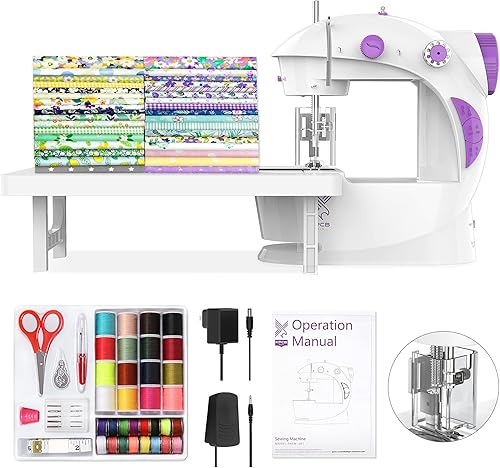
KPCB Tech Sewing Machine for Beginners with Fabrics&Finger: Best for the lightest mini option
- Mini size
- Dual speed
- Finger guard
- Double thread
- Fabric bundle and tool kit
A 3 lb mini KPCB Tech with dual speed, a finger guard, double thread design and practice fabrics for patchwork and school projects.
Pros
- 3 lb, lightest here
- Foot pedal and dual speed
- Practice fabrics and tool kit included
Cons
- Mini size limits larger projects
- Stitch count not stated in the data
The KPCB Tech mini suits beginners who need the lightest option for travel, dorm rooms and small tables. At 3 lb, it is the lightest machine in this guide, and its mini size makes storage simple.
A finger guard is included for safety, plus slow and standard stitching speed for different users. The design uses double thread, which KPCB Tech says lets it sew up to 5 layer fabrics without manual knot ending.
Treat that as a maker claim and test on scraps first.
The kit includes 20 pieces of 8 by 8 inch cotton fabric squares for patchwork and practice, plus tools such as bobbins, scissors, a measuring tape, thimble, needle threader and needles. Tutorial videos are also mentioned as a learning aid.
An extension table is listed in included components, which helps support fabric on a small machine. The trade off is workspace.
A mini body limits large projects compared with the Brother CS5055 and its larger needle to arm workspace. Stitch count is not stated in the data, so do not choose this model for stitch variety.
Pick it for portability, practice materials and low carry weight.
Janome MOD-15 Easy-to-Use Sewing Machine: Best for a metal frame on a budget
- 15 stitches
- 1 four-step buttonhole
- Adjustable stitch length and zigzag width
- 5-piece feed dog
- Free arm
A metal Janome with 15 stitches, adjustable length and zigzag width, a top loading bobbin and a free arm for everyday sewing.
Pros
- Metal body and 5-piece feed dog
- Adjustable stitch length and zigzag width
- Drop feed and free arm
Cons
- Only zipper foot listed in included components
- Fewer included feet than the Brother XM2701
The Janome MOD-15 suits buyers who want a metal frame and adjustable stitches at a budget level. It has 15 stitches, including 1 four step buttonhole, plus adjustable stitch length and zigzag width.
At 11.7 lb, it is lighter than the Janome Arctic Crystal at 13 lb and the Brother XM2701 at 12.6 lb. That difference can matter when you carry it to class each week or store it in a closet between sessions.
A top loading bobbin with a clear cover lets you see the bobbin thread. Easy threading with automatic tension helps beginners get started.
The 5 piece feed dog system is designed to move fabric evenly, and a free arm helps with cuffs and sleeves.
Drop feed is also listed, which supports free motion work with a darning plate. The trade off is included feet.
Only a zipper foot is listed in included components, while the Brother XM2701 includes 6 feet and the Brother CS5055 includes 7 feet. Pick the MOD-15 if a metal body and adjustable width matter more than a full foot set in the box.
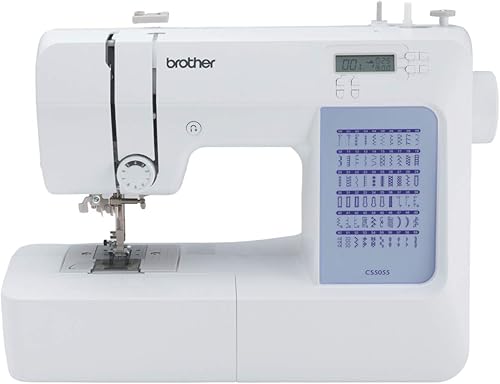
Brother CS5055 Computerized Sewing Machine with LCD: Best for computerized stitch choice
- 60 built-in stitches
- LCD display
- 7 one-step auto-size buttonholes
- Metal frame
- 7 included feet
A computerized Brother with an LCD display, 60 stitches, seven auto-size buttonholes and a larger needle to arm workspace.
Pros
- 60 stitches selected on LCD display
- 7 one-step auto-size buttonholes
- Larger needle to arm workspace
Cons
- More complex controls than mechanical picks
- Heavier than the mini models
The Brother CS5055 suits beginners and more experienced sewers who want computerized stitch selection in a portable body. It has 60 built in stitches, including utility, decorative and heirloom stitches, plus 7 one step auto size buttonholes.
At 10.5 lb, it is lighter than the Brother XM2701 and the Janome Arctic Crystal. An LCD display shows the stitch you select, which is easier to read than a dial for many users.
The metal frame and fixed needle bar are built for cleaner stitching and even lines. Brother says the larger needle to arm workspace allows work on larger projects.
That matters if you plan to sew home decor, quilts or larger garments on a lightweight machine.
Seven sewing feet, 4 bobbins and a needle set are included, along with a trilingual manual. An automatic needle threader and jam resistant drop in top bobbin are also listed.
The trade off is complexity. A mechanical model with preset settings, such as the SINGER M1500, may feel simpler on day one.
Pick the CS5055 if stitch choice and buttonhole variety matter more than dial simplicity.
Stoigeld Portable Sewing Machine for Beginners: Best for variable speed control
- Stepless speed foot pedal 0 to 400 SPM
- 12 built-in stitches
- Reverse sewing
- Compact mini size
- Starter kit included
A 4.2 lb Stoigeld mini with a stepless 0 to 400 SPM foot pedal, 12 stitches, reverse sewing and a starter kit for light fabrics.
Pros
- Stepless speed control from 0 to 400 SPM
- 12 stitches with reverse sewing
- Starter kit with threads and practice fabrics
Cons
- Best suited to light fabrics and up to 4 layers of woven fabric
- Plastic body
The Stoigeld SM-725 Pro+ suits beginners who want fine speed control in a mini machine. Its stepless foot pedal adjusts from 0 to 400 stitches per minute, so you can start very slowly and increase speed as your control improves.
At 4.2 lb, it is the second lightest pick here after the 3 lb KPCB Tech. The compact size suits apartments, dorm rooms and travel to class.
Stoigeld says it is designed for home DIY, beginner practice, daily clothes mending and gifting, not commercial or heavy duty sewing.
It has 12 built in stitches with reverse sewing to lock seams. The starter kit includes 32 thread spools, 20 practice fabrics and accessories, so you can begin without extra purchases.
Overload protection is also listed as a safety feature.
Fabric limits are clear. Stoigeld says it supports up to 4 layers of regular woven fabric, and 2 layers maximum for denim, with thin cotton, linen and light woven fabrics as the best fit.
The trade off is material and power. The body is plastic, and heavier fabrics will strain a mini machine.
Pick it for speed control and light fabric projects.
How do I choose a lightweight sewing machine for class or travel?
Choose by carry distance first, then by stitch needs. If you will carry the machine across campus or on a bus, a mini under 5 lb is easiest.
If you will drive it to a weekly class and store it at home, a 9 to 13 lb full size portable gives you more workspace.
How far will you carry it?
Measure your route. A 3 lb mini feels very different from a 13 lb machine after several blocks.
Also check storage. Mini machines fit in a closet or under a bed more easily.
What projects will you sew in class?
Class projects often need straight stitch, zigzag, blind hem and a buttonhole. A 6 stitch preset model can handle those basics.
A 12, 15 or 27 stitch model gives you more options for decorative work and stretch fabrics.
Do you want preset or adjustable stitches?
Preset length and width help beginners start fast. Adjustable width and length help you fine tune seams for patchwork, garments and light quilting.
Neither is better for everyone. Pick the control style you will actually use.
What weight is best for a lightweight sewing machine?
The best weight depends on how you will move it. Under 5 lb is best for true portability.
Between 9 and 13 lb is best for a portable full size machine.
Under 5 lb for one hand carry
The KPCB Tech at 3 lb and the Stoigeld at 4.2 lb fit this group. They suit dorms, travel and quick mending.
Expect less workspace and lighter fabric limits.
9 to 13 lb for a full size portable
The SINGER M1500 at 9.7 lb, the Brother CS5055 at 10.5 lb, the Janome MOD-15 at 11.7 lb, the Brother XM2701 at 12.6 lb and the Janome Arctic Crystal at 13 lb fit this group. They suit regular home sewing, free arm work and more included feet.
Weight alone does not tell the full story
Dimensions matter too. A wide machine can be harder to store than a slightly heavier narrow one.
Check width and depth against your table, closet and carrying bag.
How many stitches do you actually need?
Most beginners need straight stitch, zigzag, blind hem, stretch stitch and a buttonhole. Extra decorative stitches are useful, but they should not outweigh weight, threading help and included feet.
6 stitches with many applications
The SINGER M1500 and M2100 use 6 stitches to create 57 or 63 stitch applications. That means one stitch can serve several techniques with preset settings.
This is a strong choice for simple garments, mending and crafts.
12 to 15 stitches for more variety
The Chunara, Stoigeld, Janome Arctic Crystal and Janome MOD-15 offer 12 or 15 stitches. That range covers decorative work and more fabric types while staying beginner friendly.
27 to 60 stitches for broader projects
The Brother XM2701 offers 27 stitches. The Brother CS5055 offers 60 stitches with an LCD display.
Those models suit buyers who want decorative, heirloom and utility stitches without changing machines.
Which buttonhole type is easiest for beginners?
A one step auto size buttonhole is easiest, because the machine measures the button for you. A four step buttonhole is also beginner friendly when the steps are marked on the dial.
One step auto size buttonholes
The Brother CS5055 has 7 one step auto size buttonholes. The Brother XM2701 has an auto size buttonhole.
These options save time on garments and pillow covers.
Four step buttonholes with marked steps
The SINGER M1500, SINGER M2100, Janome Arctic Crystal and Janome MOD-15 use four step buttonholes. The steps are marked to guide you through each pass.
What to practice first
Practice on the same fabric type you will use for the project. Buttonholes can pucker on light fabrics, so test stitch length and stabilizer choices on scraps before you sew the real garment.
How do I set up and care for a lightweight sewing machine?
Set up is simple when you follow the manual in order. Thread the machine with the spool pin down, wind the bobbin, thread the needle and test on scrap fabric.
Threading and bobbin basics
Use the threading guides on the machine where they are provided. The Brother models use a drop in top bobbin, which is easy to load.
The Janome MOD-15 also uses a top loading bobbin with a clear cover.
Thread weight affects stitch quality. Our guide on What Weight Thread for Machine Embroidery? helps you match thread to fabric.
Bobbin thread matters too, so read What Bobbin Thread Weight Should I Use?: A Complete Guide before you change settings.
Speed control for beginners
Dual speed minis let you start slow and increase pace. The Stoigeld offers stepless control from 0 to 400 SPM.
A foot pedal also frees both hands, which helps with quilting and patchwork.
Safety and storage
Keep fingers away from the needle while the machine runs. Our guide on how to use a sewing machine safely covers safe habits for new users.
Store the machine with a dust cover where possible, and keep needles and bobbins in a small case.
Lightweight sewing machine vs mini sewing machine: which should you buy?
A lightweight full size machine gives you more workspace, more feet and steadier fabric handling. A mini sewing machine gives you the lightest carry and the smallest storage footprint.
Choose a full size portable for regular sewing
The Brother XM2701, SINGER M1500, Janome Arctic Crystal and Brother CS5055 suit regular sewing at home. They have free arms, more feet and broader stitch options.
Choose a mini for travel and quick jobs
The KPCB Tech, Stoigeld and Chunara suit travel, dorms and quick mending. They are easier to carry, but they have smaller work areas and tighter fabric limits.
Choose by project size
If you sew curtains, quilts or large garments, a full size portable will feel less cramped. If you sew small crafts, repairs and school projects, a mini may be all you need.
Our best small lightweight sewing machine guide goes deeper on compact models. Our best brother portable sewing machine guide focuses on Brother stitch selection and included feet.
Verdict: which lightweight sewing machine should you buy?
Pick the Brother XM2701 if you want the best all around portable machine with 27 stitches, a free arm and six feet. Pick the SINGER M1500 if preset stitch settings and a 9.7 lb body matter most for class.
Pick the Janome Arctic Crystal if you want adjustable stitch width and length with a metal frame. Pick the Brother CS5055 if an LCD display and 60 stitches matter more than dial simplicity.
Pick the KPCB Tech if you need the lightest 3 lb option for travel. Pick the Stoigeld if stepless speed control from 0 to 400 SPM matters more than a metal frame.
Pick the Chunara if you want a mini with a foot pedal and a 42 piece kit.
For most buyers shopping for the best lightweight sewing machine, the Brother XM2701 is the safest first choice. It carries well, sews a wide range of everyday projects and includes the feet you need to start.
Next, compare your carry route and project size, then choose the preset, adjustable or mini model that fits that routine.
Our top 3 picks at a glance
-
1
-
2
Best for preset stitch settings
SINGER® M1500 Lightweight & Portable Sewing Machine
9.5/10 our score
See it on Amazon -
3
Best for adjustable stitch control
Janome Arctic Crystal Easy-to-Use Sewing Machine
9.2/10 our score
See it on Amazon
Frequently asked questions
What weight counts as a lightweight sewing machine?
For this guide, lightweight ranges from about 3 lb for mini machines to about 13 lb for full size portable models. Choose by how far you carry it.
A mini suits class and travel.
A 10 to 13 lb model suits more regular home sewing with a free arm and more feet.
Can a lightweight sewing machine handle quilting?
Some can handle light quilting and piecing, especially models with a darning plate and adjustable stitch settings. The Janome Arctic Crystal lists light quilting and patchwork.
Mini machines are better suited to small crafts and mending than large quilts.
Are mini sewing machines good for beginners?
Yes, for simple mending, crafts and school projects. Dual speed and a foot pedal help you start slowly.
Check stitch count, fabric limits and included kit before you buy, because mini models have less workspace than full size portable machines.
What should I pack when taking a sewing machine to class?
Pack the machine, foot pedal, power cord, needles, bobbins, seam ripper and the feet you plan to use. A soft dust cover or sturdy bag helps.
Label the bobbin and needle pack so you can rethread quickly in class.
How do I move a sewing machine between workspaces?
Use a lift with two hands and keep the machine level. Store the spool pin and detachable parts so they do not snag.
Let the machine settle on a flat surface before you plugin and test a straight stitch on scrap fabric.


